The Second Autopsy Couldn’t Determine How Nolan Wells Died. Here’s What That Means.


On Wednesday, attorney Ben Crump held a press conference regarding Nolan Wells’ independent autopsy. During the NAACP conference, preliminary findings from the examination were released.
The report, prepared by board-certified forensic pathologist Dr. Roger A. Mitchell Jr. of RAM Consulting LLC for the Benjamin Crump Law Firm, is dated July 19, 2026. The independent autopsy was performed July 10, 2026.
After reviewing the preliminary findings, one thing remains clear: the examination did not determine how Nolan Wells died.


Cause of death: Undetermined: Pending Investigation
Manner of death: Undetermined: Pending Investigation
Date of death: Unknown
This is an analysis of the information currently available from the preliminary autopsy report, including what was discovered, what could not be evaluated, and the questions that remain unanswered.
Foul Play Cannot Be Ruled Out
This is according to the forensic pathologist.
When a report states that foul play cannot be ruled out, it means the available evidence does not allow investigators to eliminate that possibility.
At this stage, the available evidence does not provide enough information to determine how Nolan Wells died. Additional records, testing, and cooperation between agencies may be necessary to answer those remaining questions.
The Missing Throat
This is one of the most significant findings in the report.
Nolan Wells’ anterior neck structures (including the tracheal and laryngeal cartilage, thyroid horn, and hyoid bone) were not received with the body for the second autopsy.
In plain terms: Nolan’s throat was missing
Dr. Mitchell notes that it is common practice for these structures to be retained by the pathologist who performs the initial autopsy. However, without those structures, the second examination could not evaluate whether there were injuries to the neck, including possible fractures or soft tissue trauma.
To review those structures now, Dr. Mitchell would need authorization from the Mississippi Medical Examiner. According to the preliminary report, that review had not occurred at the time of the examination.
The remaining question is whether there were injuries to the neck structures, but those structures were not available for examination during the second autopsy.
A Body Too Decomposed to Read
By the time the body reached Dr. Mitchell on July 10, decomposition had advanced enough to limit what could be determined from the examination.
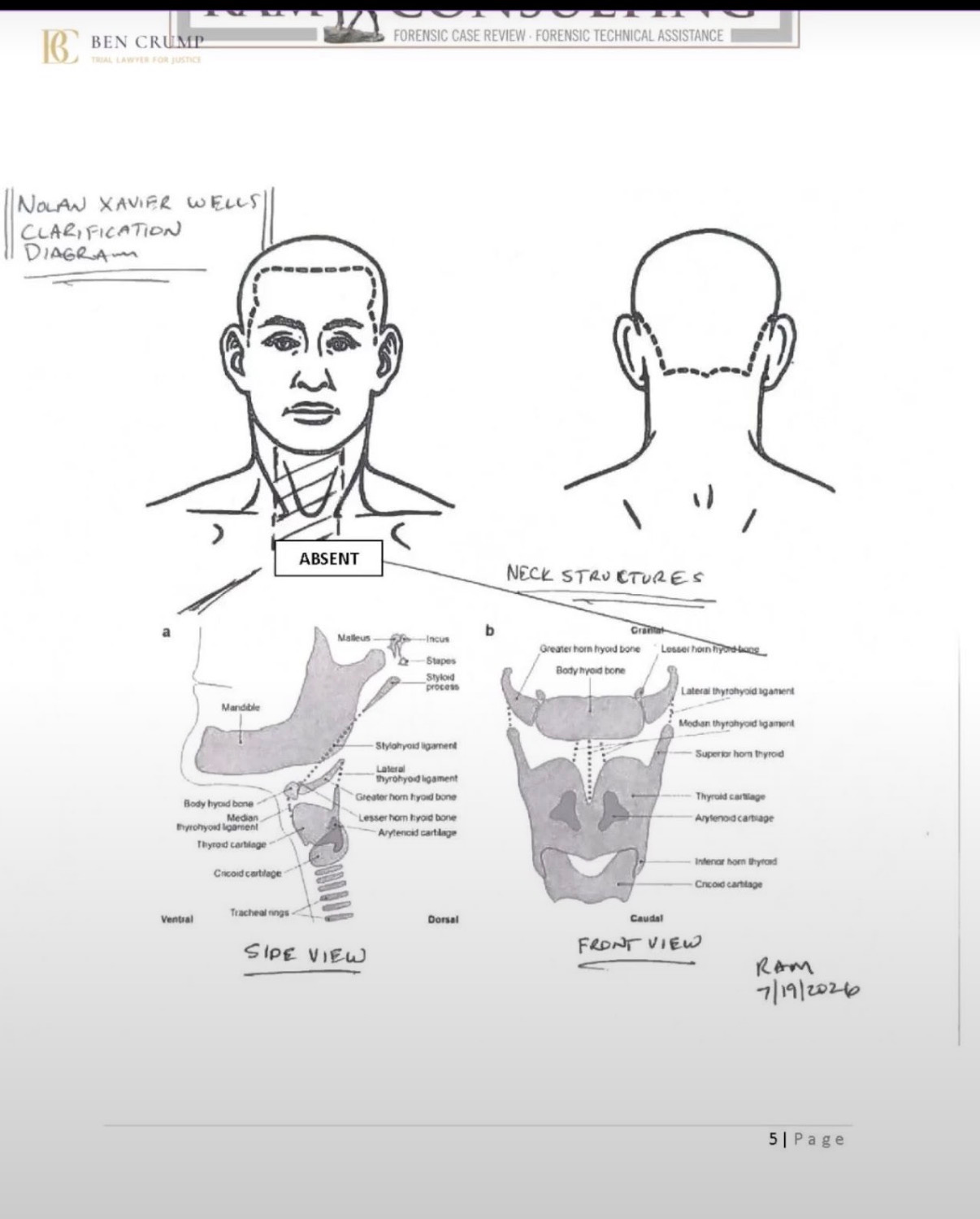
The report notes that decomposition affected the ability to evaluate whether bruises or abrasions were present.
Decomposition can complicate forensic review because some injuries or findings may no longer be visible.
One finding that was identified was an 12x8 inch area of red discoloration in the deep soft tissue over the back of the skull, in the occipital region.
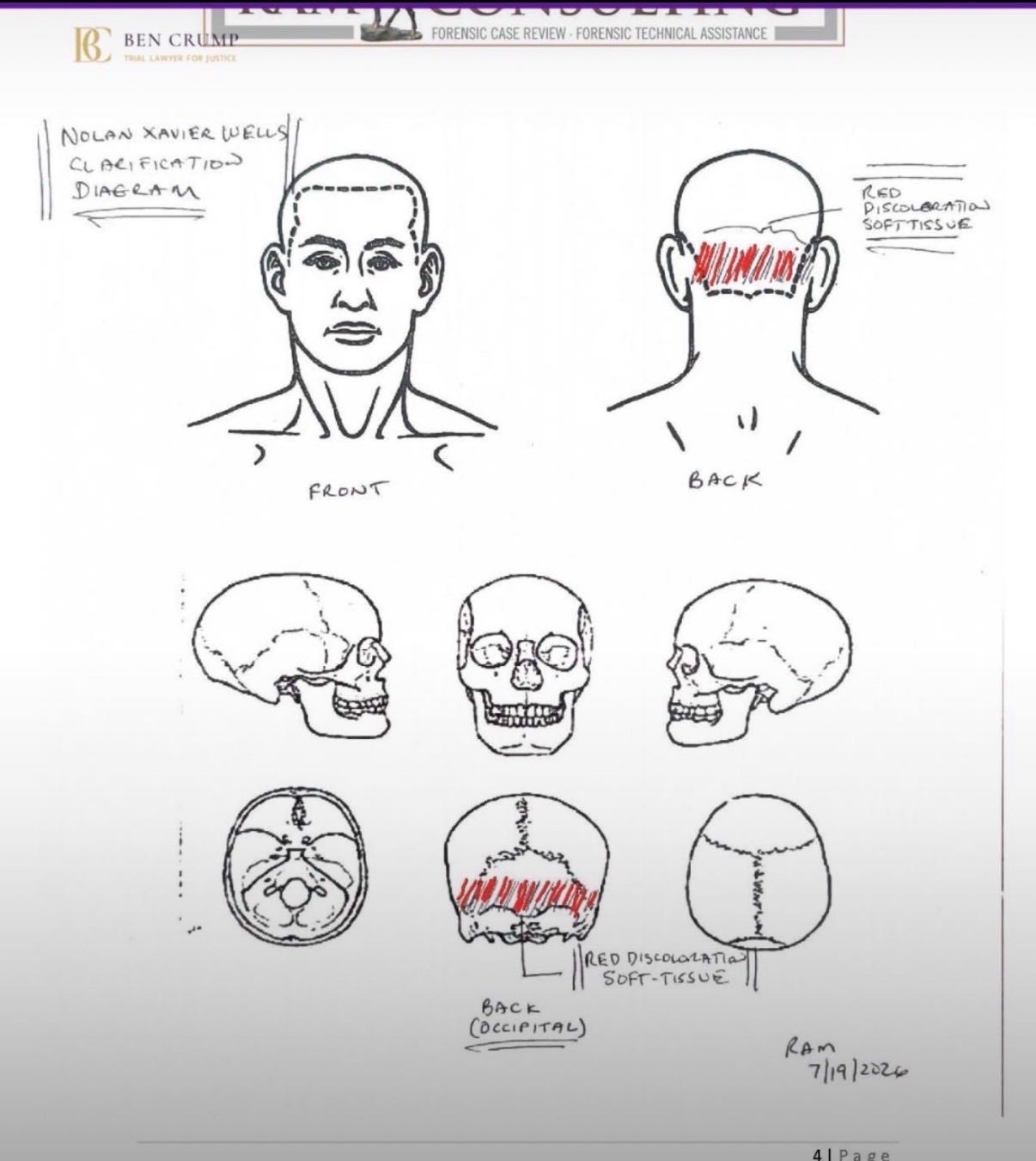
There were no skin lacerations and no skull fractures. The finding was classified as inconclusive, but it was significant enough that Dr. Mitchell documented it for further investigation.
Importantly, this finding was not identified during the first autopsy because the posterior head and neck dissection needed to evaluate that area was not performed during the initial examination.
No Way to Check for Water, No Way to Check the Stomach
Because organs had already been removed and dissected during the first autopsy, the second examination had limitations.
Dr. Mitchell could not directly evaluate the airway and lungs for the presence of water. He also could not directly examine the stomach for gastric contents.
In a case involving a possible drowning, those findings can provide important information. However, they could not be independently assessed during the second examination.
Toxicology: Still Pending
At the time the preliminary report was issued, the original toxicology results had not been received.
That means the available information does not yet show what substances, if any, were present in Nolan Wells’ system at the time of death.
The toxicology report remains an outstanding piece of evidence.
How Did Nolan Wells Enter the Water?
One of the biggest unanswered questions remains how Nolan Wells entered the water.
Was he conscious or unconscious? Did he enter voluntarily, or was he placed there?
Dr. Mitchell noted that these circumstances are significant when determining both cause and manner of death.
Without that information, investigators may be limited in determining how the death occurred.
The Seven Questions Still Standing
Dr. Mitchell identified several outstanding questions that remain critical to determining what happened:
What were the circumstances that led to Nolan Xavier Wells entering the water?
What was the body position when found?
Was there water in the airway?
Is there evidence of injuries to the anterior neck structures?
Is there evidence of intracranial hemorrhage, including subdural or subarachnoid bleeding?
What was the composition of the stomach contents?
What are the toxicology findings?
These questions remain unanswered.
The Bottom Line
The second autopsy was not a complete recreation of the first examination. Dr. Mitchell documented several limitations: missing neck structures, organs already examined, decomposition affecting evaluation, toxicology still pending, and unanswered questions about how Nolan Wells entered the water.
Those gaps are significant because they affect the ability to determine both cause and manner of death.
For now, the classification remains:
Cause of death: Undetermined: Pending Investigation
Manner of death: Undetermined: Pending Investigation
The next major developments will likely come from toxicology results, additional records, and whether further examination of retained neck structures is permitted.
The Docket Diva covers the intersection of court documents, investigations, and the stories behind the headlines.